
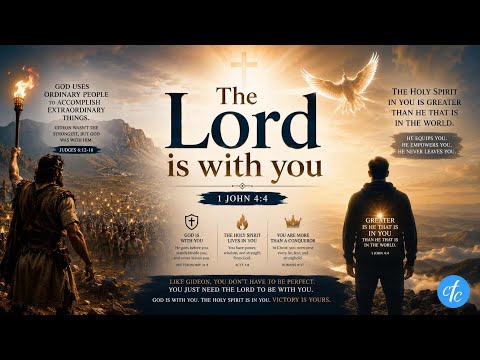
This small group discussion guide draws directly from Christian Fellowship Church🔹Pastor Scott Cheramie's sermon “The Lord is with you - 2026-06-08” so you can keep engaging with the message all week. Read, reflect, and share it with your small group or friends.
Small Group Discussion Guide
"The Lord Is With You"
Based on Sunday's Sermon from Judges 6 | Week of June 4, 2023
A Note to Facilitators: Welcome! This guide is designed to help your group engage with Sunday's message in a meaningful, personal way. You don't need to be a theological expert to lead a great discussion — your job is simply to create space for honest conversation and guide the group through these questions. Feel free to skip questions that don't fit your group, and never feel pressure to cover everything. The goal is connection and transformation, not completion.
Estimated Total Time: 60–90 minutes Best Group Size: 4–12 people
📋 OVERVIEW
(For Facilitator Reference)
This week's message centered on a powerful truth: God is with us — not just in the good times, but especially in our moments of fear, hiding, and discouragement. Drawing from the story of Gideon in Judges 6, the sermon showed us that God often sees something in us that we can't yet see in ourselves. Just as God called Gideon a "mighty warrior" while he was hiding in a winepress, God calls us to step into our purpose through His grace and presence — not through our own strength, willpower, or performance. Our strength to face every condition in life comes from the grace of Jesus Christ, beautifully illustrated through communion and the key verses Philippians 4:13 and 2 Timothy 2:1.
🧊 ICEBREAKER
(5–10 minutes)
Before diving into the sermon content, start with this lighter opening question to help everyone feel comfortable sharing.
Question: Think of a time when someone saw potential in you that you couldn't see in yourself — maybe a teacher, parent, coach, mentor, or friend. What did they say, and how did it make you feel?
[Leader Tip]: This question is intentionally lighthearted and accessible for everyone, regardless of spiritual background. It naturally sets up the theme of God seeing us differently than we see ourselves. Give everyone a chance to share briefly — even one sentence is fine. You can go first to model the kind of sharing you're hoping for.
📖 SCRIPTURE READING
(5 minutes)
Have someone in the group read each passage aloud. You may want to assign these ahead of time.
Passage 1 — The Central Story
Judges 6:11–16 (NIV)
"The angel of the Lord came and sat down under the oak in Ophrah that belonged to Joash the Abiezrite, where his son Gideon was threshing wheat in a winepress to keep it from the Midianites. When the angel of the Lord appeared to Gideon, he said, 'The Lord is with you, mighty warrior.'
'Pardon me, my lord,' Gideon replied, 'but if the Lord is with us, why has all this happened to us? Where are all his wonders that our ancestors told us about when they said, "Did not the Lord bring us up out of Egypt?" But now the Lord has abandoned us and given us into the hand of Midian.'
The Lord turned to him and said, 'Go in the strength you have and save Israel out of Midian's hand. Am I not sending you?'
'Pardon me, my lord,' Gideon replied, 'but how can I save Israel? My clan is the weakest in Manasseh, and I am the least in my family.'
The Lord answered, 'I will be with you, and you will strike down all the Midianites, leaving none alive.'"
Passage 2 — Our Strength Comes from Grace
2 Timothy 2:1 (NIV)
"You then, my son, be strong in the grace that is in Christ Jesus."
Passage 3 — Strength for Every Condition
Philippians 4:13 (Good News Translation)
"I have the strength to face all conditions by the power that Christ gives me."
Passage 4 — Greater Is He
1 John 4:4 (NIV)
"You, dear children, are from God and have overcome them, because the one who is in you is greater than the one who is in the world."
[Context Note for Facilitators]: The Midianites were a powerful enemy who had been oppressing the Israelites for seven years. They would raid crops and livestock, leaving the people in poverty and fear. That's why Gideon was threshing wheat inside a winepress — a hidden pit — instead of on a hilltop where the wind could carry the chaff away. He was afraid of being seen. Keep this image in mind as you discuss: God found Gideon at his lowest point, in hiding, and called him something he couldn't yet believe about himself.
💬 DISCUSSION QUESTIONS
(30–45 minutes)
Work through as many of these as time allows. Questions are organized to move from observation to personal application. You don't need to cover all of them — choose the ones that feel most relevant to your group.
THEME 1: Seeing Ourselves vs. How God Sees Us
(Questions 1–3)
1. In the sermon, the pastor pointed out that Gideon was hiding in a winepress — scared and overwhelmed — when the angel called him a "mighty warrior." What do you think Gideon felt when he heard those words? Why do you think his first reaction was to argue with the angel?
[Leader Tip]: This is an observational question to get the group thinking about the text. Encourage people to put themselves in Gideon's shoes. There's no wrong answer here — you're looking for honest engagement with the story. If the group is quiet, try asking, "Have you ever been told something about yourself that felt completely unbelievable at the time?"
2. The sermon mentioned that sometimes we see ourselves as less than we are, while other times (like Peter before the crucifixion) we can overestimate ourselves. What are some of the most common ways people underestimate what God can do through them?
3. Ephesians 2:10 says we are "created in Christ Jesus to do good works, which God prepared in advance for us to do." The pastor described God as an author who already knows how the story ends, even when we're only in the middle. How does that picture change the way you think about the difficult chapters you're currently in?
[Leader Tip]: This question can open up some deep and vulnerable sharing. Be prepared for silence — that's okay. Give people a moment to think before moving on. If someone shares something painful, resist the urge to fix it or rush past it. A simple "Thank you for sharing that" goes a long way.
THEME 2: The Lord Is With You
(Questions 4–5)
4. The sermon walked through several Bible characters — Moses, Joshua, Jeremiah, and Jesus's own words in Matthew 28 — all of whom received the same assurance: "I will be with you." Why do you think God's first response to people He calls is almost always a promise of His presence rather than a promise to remove their difficulties?
5. The pastor made a statement that stood out: "The absence of evidence does not mean the absence of presence." Can you think of a time in your own life when you felt like God was absent or silent — but later realized He had been working all along? What did that experience teach you?
[Leader Tip]: This is one of the most personal questions in the guide. Not everyone will feel comfortable sharing right away. You might share your own brief example first to model vulnerability. It's also perfectly fine if someone says, "I'm still in that season right now and I haven't seen it yet" — that's an honest and valid place to be. Don't try to resolve it too quickly.
THEME 3: Strength Through Grace
(Questions 6–8)
6. We often think of strength and grace as opposites — strength feels like muscle and determination, while grace feels like something gentle and undeserved. But Paul tells Timothy to "be strong in the grace that is in Christ Jesus." What do you think it actually looks like in everyday life to draw your strength from grace rather than from your own willpower?
7. The sermon used communion as a reminder that our relationship with God is built not on what we have done for Him, but on what He has done for us. In what areas of your spiritual life are you most tempted to rely on your own performance or effort rather than resting in what Christ has already provided?
[Leader Tip]: This question gets at a deeply common struggle — the tendency toward "doing" rather than "receiving." Be careful not to let this become a guilt conversation. The goal is honest self-reflection, not shame. You might frame it by saying, "We all drift toward self-reliance — what does that look like for you personally?"
8. The pastor described us as "flashlights without batteries" — fully designed for a purpose, but unable to fulfill it without the power source. Using that image, where in your life right now do you feel like you're running on empty or trying to shine without being connected to the power source?
THEME 4: Excuses, Trust, and Waiting on God
(Questions 9–10)
9. Gideon gave God a list of reasons why he was the wrong person for the job — his family was the weakest, his clan was the least. The sermon also mentioned Moses ("I can't speak"), Jeremiah ("I'm too young"), and Abraham and Sarah's attempt to "help God along" by their own plan. What excuses do you find yourself most often giving God about why He can't use you — or why a situation in your life is beyond His ability to fix?
10. The sermon described Abraham as believing "against all hope" — trusting God's promise even when every circumstance pointed the other way. What makes it so hard to trust God when we can't see Him working? What has helped you personally hold on to faith in those moments?
🪞 PERSONAL APPLICATION
(10–15 minutes)
These questions are for quieter, more personal reflection. You may want to give people a minute to think silently before sharing, or invite people to share only if they feel comfortable.
1. If God were to speak to you right now the way He spoke to Gideon — calling you something you haven't yet believed about yourself — what do you think He might say? What's standing in the way of you receiving that?
2. The sermon connected Philippians 4:13 to facing difficult conditions, not just achieving great things. What specific "condition" are you facing right now that you need the strength of Christ to face — not necessarily to fix, but simply to get through?
3. On a scale of 1–10, how much are you currently drawing your daily strength from God's grace versus your own effort and determination? What would it look like to shift that dial even slightly this week?
4. Is there an area of your life where, like Abraham and Sarah, you've been tempted to "help God along" with your own plan because His timing feels too slow? What might it look like to surrender that to Him this week?
🎯 THIS WEEK'S CHALLENGE
(Choose one that fits where you are)
[Leader Tip]: Read these options aloud and invite group members to share which one they're choosing. Following up on these at your next meeting creates accountability and deepens community.
Option A — For Everyone: Each morning this week, before your feet hit the floor, say out loud: "The Lord is with me today." Notice how that simple declaration changes the way you approach the day. At the end of the week, journal or reflect on any difference you noticed.
Option B — For Those Feeling Overwhelmed: Identify the one situation in your life right now where you feel most like Gideon — hiding, afraid, or overwhelmed. Write it down. Then write 2 Timothy 2:1 next to it: "Be strong in the grace that is in Christ Jesus." Pray over it daily this week, asking God to show you His presence in that specific situation.
Option C — For Those Ready to Step Out: Think about the "good work" God may be calling you toward — something you've been putting off because you feel unqualified, afraid, or unprepared. Take one small, concrete step toward it this week. It doesn't have to be big. Tell someone in your group what that step is so they can encourage you.
Option D — For Those Who Want to Go Deeper: Read the full story of Gideon in Judges 6–8. As you read, pay attention to every moment Gideon doubted and every moment God reassured him. What patterns do you notice? What does the full arc of Gideon's story tell you about how God develops people over time?
🙏 PRAYER FOCUS
(5–10 minutes)
Close your time together in prayer. Here are suggested prayer topics — you can pray through them as a group, in pairs, or have one person pray over all of them.
Pray Together For:
Presence: Thank God that He is with each person in the group — especially those who are in a "winepress" season right now.
Identity: Ask God to help each member of your group see themselves the way He sees them — not defined by their failures, fears, or weaknesses, but by His purpose and calling.
Strength through Grace: Pray that each person would learn to draw their strength from Christ's provision rather than their own effort — especially in the specific battles they're facing.
Trust: Lift up anyone in the group who is in a "waiting season" — where God's promise hasn't come to pass yet and faith is being stretched. Ask God for the faith of Abraham: to believe "against all hope."
Specific Needs: Invite group members to share one specific prayer request — something they're facing this week where they need God's presence and strength.
[Leader Tip]: If your group is comfortable with it, consider praying specifically for each person by name. Even brief, simple prayers like "Lord, be with [name] this week as they face [situation]" can be profoundly meaningful. If your group is newer or quieter, a single closing prayer covering all the topics above works just as well.
🔍 OPTIONAL DEEP DIVE
(For groups wanting to go further — use if time allows or as a take-home study)
Bonus Question 1: The sermon mentioned that God changed the names of several people after encountering them — Abram became Abraham, Simon became Peter, Saul became Paul. A name change in Scripture often signaled a new identity and calling. Read Genesis 17:1–8 (Abram to Abraham) and John 1:40–42 (Simon to Peter). What do these name changes tell us about how God views transformation? How does your identity in Christ differ from how the world — or even you — would define you?
Bonus Question 2: Paul writes to Timothy from prison, facing his own execution, and still tells him to "be strong in the grace that is in Christ Jesus." Read 2 Timothy 1:6–12 for more context. Given Paul's circumstances when he wrote this, how does that change the weight of his words? What does it mean that Paul could write about strength and grace from a prison cell?
Bonus Question 3: The sermon described grace not only as something that saves us from our past, but as an ongoing power that sustains us in our present. Read Romans 5:1–5. According to this passage, what does grace actually produce in a person's life over time? How does suffering fit into that process? Does this passage change how you think about the difficult seasons you've walked through?
📚 RELATED SCRIPTURES FOR FURTHER STUDY
| Topic | Passage |
|---|---|
| God's presence with us | Deuteronomy 31:6; Psalm 139:7–12; Isaiah 41:10 |
| Grace as ongoing strength | Romans 5:1–5; 2 Corinthians 12:9–10; Hebrews 4:16 |
| God's purpose for our lives | Jeremiah 29:11; Romans 8:28–30; Ephesians 2:10 |
| Faith against all odds | Hebrews 11:1–12; Romans 4:17–22 |
| Full story of Gideon | Judges 6–8 |
📝 FACILITATOR CHECKLIST
Before your group meets, take a few minutes to:
- Read through the full guide and choose which questions fit your group best
- Read Judges 6:1–16 in full for background context
- Identify 2–3 questions you want to make sure you cover
- Think of a personal example you could share for Question 5 (God working unseen)
- Pray for your group members by name before they arrive
- Have Bibles or the scripture passages available for those who need them
- Plan which "This Week's Challenge" you will personally choose, so you can share it
This guide was prepared for small group use following the Sunday morning message. For questions about this guide or small group ministry, please contact your church office.
"The Lord is with you, mighty warrior." — Judges 6:12