
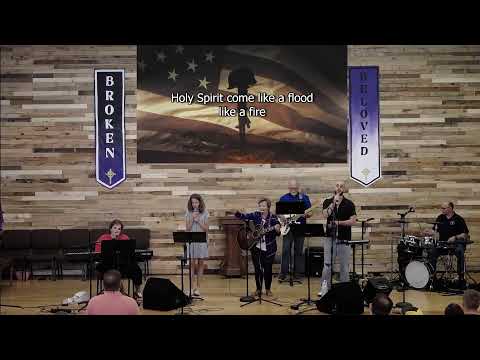
This small group discussion guide draws directly from Drew Reding's sermon “Road Trip - God Makes a Way | Drew Reding | Grace Community Fellowship - 2026-05-25” so you can keep engaging with the message all week. Read, reflect, and share it with your small group or friends.
Small Group Discussion Guide
"Roads Where None Exist" — Exodus 14:10-22
Sermon Series: Road Trip | Week 2
A Note to Facilitators: Welcome, and thank you for leading your group this week! This guide is designed to work whether you're an experienced elder or leading a small group for the first time. You don't need to have all the answers — your job is simply to create space for honest conversation. Feel free to skip questions that don't fit your group, and don't worry if discussion takes you in an unexpected direction. Sometimes that's exactly where the Holy Spirit wants you to go. Estimated total time: 60–90 minutes.
OVERVIEW
This week's sermon from Exodus 14 found the Israelites in an impossible situation — the Red Sea ahead and Pharaoh's army closing in behind. Pastor Drew drew three powerful truths from this story: we are quick to forget what God has already done; God fights for us even when we stop striving; and God specializes in making roads through impossible places, not always around them. The big idea: God specializes in making roads where none exist.
SECTION 1 — ICEBREAKER
(5–10 minutes)
Choose one of the following to open your time together:
Option A (lighter, fun):
"Tell us about a time you were completely lost — on a road trip, hiking, or just in an unfamiliar city. What happened, and how did you find your way?"
Option B (slightly more reflective):
"What's one thing you're looking forward to this summer, and one thing you're a little anxious about?"
[Leader Tip]: The icebreaker is just meant to get people talking and comfortable. Don't let it run too long — aim for 5–7 minutes. If your group is quiet, share your own answer first to model vulnerability and set the tone.
SECTION 2 — SCRIPTURE READING
(5 minutes)
Ask a volunteer to read the passage aloud. Encourage the group to listen for what stands out to them — a word, a phrase, an image, or a question.
Exodus 14:10–22 (ESV)
"When Pharaoh drew near, the people of Israel lifted up their eyes, and behold, the Egyptians were marching after them, and they feared greatly. And the people of Israel cried out to the Lord. They said to Moses, 'Is it because there are no graves in Egypt that you have taken us away to die in the wilderness? What have you done to us in bringing us out of Egypt? Is not this what we said to you in Egypt? Leave us alone that we may serve the Egyptians. For it would have been better for us to serve the Egyptians than to die in the wilderness.' And Moses said to the people, 'Fear not, stand firm, and see the salvation of the Lord, which he will work for you today. For the Egyptians whom you see today, you shall never see again. The Lord will fight for you, and you have only to be silent.' The Lord said to Moses, 'Why do you cry to me? Tell the people of Israel to go forward. Lift up your staff and stretch out your hand over the sea and divide it, that the people of Israel may go through the sea on dry ground. And I will harden the hearts of the Egyptians so that they shall go in after them, and I will get glory over Pharaoh and all his host, his chariots, and his horsemen. And the Egyptians shall know that I am the Lord when I have gotten glory over Pharaoh, his chariots, and his horsemen.' Then the angel of God who was going before the host of Israel moved and went behind them, and the pillar of cloud moved from before them and stood behind them, coming between the host of Egypt and the host of Israel. And there was the cloud and the darkness. And it lit up the night without one coming near the other all night. Then Moses stretched out his hand over the sea, and the Lord drove the sea back by a strong east wind all night and made the sea dry land, and the waters were divided. And the people of Israel went into the midst of the sea on dry ground, the waters being a wall to them on their right hand and on their left."
Additional Passages Referenced in the Sermon:
Isaiah 43:1–3a (ESV) "Fear not, for I have redeemed you; I have called you by name, you are mine. When you pass through the waters, I will be with you; and through the rivers, they shall not overwhelm you; when you walk through fire you shall not be burned, and the flame shall not consume you. For I am the Lord your God, the Holy One of Israel, your Savior."
Psalm 23:4 (ESV) "Even though I walk through the valley of the shadow of death, I will fear no evil, for you are with me; your rod and your staff, they comfort me."
John 15:12–14 (ESV) "This is my commandment, that you love one another as I have loved you. Greater love has no one than this, that someone lay down his life for his friends. You are my friends if you do what I command you."
SECTION 3 — DISCUSSION QUESTIONS
(30–45 minutes)
Work through as many questions as time allows. The questions move from observation (easier) to application (deeper). You don't have to cover every question — choose what fits your group best.
THEME 1: Recognizing the Impossible Situation
(~10 minutes)
1. What stood out to you most from Sunday's message — a story, a phrase, a scripture, or an idea? Why did that particular thing catch your attention?
[Leader Tip]: This is a great "landing" question that helps people reconnect with the sermon before diving deeper. There are no wrong answers here. If someone didn't make it to the service, invite them to share what stood out from the scripture reading just now.
2. Put yourself in the Israelites' sandals for a moment. They had just witnessed plagues, the Passover, and a miraculous escape from Egypt — and yet when they saw Pharaoh's army, they panicked and said it would have been better to stay as slaves. What does that reaction tell us about how fear affects the way we think?
[Leader Tip]: This question is designed to build empathy for the Israelites rather than judge them. Gently redirect if the group becomes critical of the Israelites — the goal is self-reflection, not superiority. A good follow-up: "When have you found yourself thinking something similar — that a hard situation was better than the unknown ahead?"
3. Pastor Drew used the phrase "anxiety causes spiritual amnesia." What do you think he meant by that? Have you ever experienced a moment where fear made you temporarily forget what God had already done for you?
THEME 2: God Fights for You
(~10 minutes)
4. Moses told the Israelites, "The Lord will fight for you, and you have only to be silent." That's a surprising command. What do you think it means to "be silent" in the middle of a crisis? What does that look like practically in your life?
[Leader Tip]: This question may surface some tension — some people will feel that "being silent" sounds passive or even irresponsible. That's a healthy tension to explore. Help the group think about the difference between trusting God and doing nothing, and how those are not always the same thing. A good follow-up: "Is there a difference between being silent before God and being passive in a situation?"
5. Pastor Drew compared our struggles to being caught in quicksand — the more we flail, the deeper we sink. He said that our rescue often comes from outside the quicksand, not from our own effort. How does that image connect to your own experience? When have you found that your own striving made things worse rather than better?
6. Notice that God placed the pillar of cloud between the Israelites and the Egyptian army — essentially standing in the gap for his people all night long. What does this image of God as a protector and barrier mean to you personally? How does it change the way you think about the battles you're facing right now?
THEME 3: God Opens Impossible Paths
(~10 minutes)
7. Pastor Drew made the observation that God didn't remove the Red Sea — he made a way through it. He said, "God delivers through, not around." How does that reframe the way you think about difficult seasons that don't seem to end? What might God be doing in the difficulty rather than just removing it?
[Leader Tip]: This is one of the most important questions in the guide. Be sensitive — some people in your group may be in the middle of a very painful season right now and may struggle with this idea. Don't rush to resolution. It's okay to sit with the difficulty of this truth. If someone is hurting, affirm their pain before moving to the theological point.
8. In Isaiah 43, God says: "Fear not, for I have redeemed you; I have called you by name, you are mine." What does it mean to you personally that God knows your name? How does that specific, personal dimension of God's character change the way you approach him in hard times?
9. Pastor Drew suggested that the obstacles God helps us through can become testimonies of his faithfulness. Is there a "Red Sea" in your past — a situation that seemed impossible — that you can now look back on as evidence of God's faithfulness? What did you learn about God through that experience?
[Leader Tip]: This question invites personal testimony, which can be deeply encouraging for the whole group. If the group is quiet, you might share your own example first. Be mindful of time — this question can naturally take longer if people open up. That's a good thing, but keep an eye on the clock so you have time for application.
SECTION 4 — PERSONAL APPLICATION
(10–15 minutes)
These questions are more reflective. Invite people to think quietly for a moment before sharing, and remind them that they're welcome to share as much or as little as they're comfortable with.
1. Pastor Drew asked: "What Red Sea are you facing today?" Take a moment to think honestly about that. What feels impossible in your life right now — a relationship, a financial situation, a health concern, a decision, a season of doubt? You don't have to share details, but name it for yourself.
2. Of the three truths from the sermon — (a) we are quick to forget, (b) God fights for us, (c) God opens impossible paths — which one do you most need to hold onto right now, and why?
3. Is there an area of your life where you've been "flailing in the quicksand" — striving, worrying, or trying to control something — that might need to be surrendered to God? What would it look like to "be still" in that area this week?
4. Who in your life needs to hear the truth that God makes roads where none exist? How might you share that encouragement with them this week — through a conversation, a text, a meal, or simply being present?
[Leader Tip]: These questions invite vulnerability. Create a safe, grace-filled atmosphere by reminding your group that what's shared here stays here. If someone shares something heavy, don't rush past it — acknowledge it, and consider making it part of your prayer time. You don't need to fix anything; your presence and listening is ministry.
SECTION 5 — THIS WEEK'S CHALLENGE
(Read aloud or distribute as a take-home)
Choose one of the following to practice this week:
🔵 Remember: Make a list of 3–5 moments in your life when God showed up in a way you didn't expect. Keep the list somewhere visible this week as a reminder when anxiety creeps in.
🟢 Be Still: Identify one area where you've been striving or worrying. Practice a daily moment of intentional silence — even just 5 minutes — and ask God to fight for you in that area.
🟡 Tell It: Share a testimony of God's faithfulness with someone this week — a friend, a family member, or someone in your small group. Let your story become encouragement for someone else.
🔴 Go Forward: Is there a step of faith you've been avoiding — something God has been nudging you toward but fear has kept you from? Take one small step forward this week, trusting that God goes before you.
SECTION 6 — PRAYER FOCUS
(5–10 minutes)
Close your time together in prayer. Here are some suggested ways to structure your prayer time:
Suggested Prayer Topics:
- Thank God for specific moments of faithfulness — past "Red Seas" he has already parted
- Pray for the courage to "be still" and trust God in current impossible situations
- Pray for those in your group (and in your church family) who are facing hard seasons right now
- Pray for the Holy Spirit to go with each person as they "go forward" this week
- Pray for those who are grieving — including those who have lost loved ones in service to our country, whose sacrifice we remembered this Memorial Day
Suggested Prayer Format Options:
Option A — Popcorn Prayer: Invite anyone who wants to pray aloud to offer a short sentence prayer. Close with a pastoral prayer from the leader.
Option B — Written Prayers: Give everyone a notecard. Ask them to write one thing they're trusting God with this week and one thing they're thankful for. Collect the cards and pray over them together.
Option C — Partner Prayer: Break into pairs and give each person 2 minutes to share a prayer request, then pray briefly for one another. Reconvene and close together.
Option D — Leader-Led: The facilitator closes in prayer, incorporating themes from the discussion.
SECTION 7 — OPTIONAL DEEP DIVE
(For groups with extra time or who want to go further)
1. The sermon is part of a series called "Road Trip," exploring journeys of biblical characters. Read the broader context of Exodus 14 (verses 1–31 if time allows). What do you notice about Moses's leadership in this passage? How does he model both trust in God and courage for the people? What can we learn from his example about leading others through uncertainty?
2. Psalm 103 — read aloud by the congregation during the service — describes God as one who "forgives all your iniquities, heals all your diseases, redeems your life from destruction, and crowns you with loving kindness." How does this picture of God connect to the God we see in Exodus 14? What does it mean that this same God is the one who "makes roads where none exist" in your life?
3. The children's message referenced John 15:13 — "Greater love has no one than this, that someone lay down his life for his friends." The sermon also briefly connected Memorial Day's theme of sacrifice to Jesus's sacrifice. How do these two kinds of sacrifice — the sacrifice of soldiers and the sacrifice of Jesus — both call us to respond with gratitude and purpose? How does remembering sacrifice (of any kind) shape the way we live?
QUICK REFERENCE — KEY SCRIPTURES
| Passage | Theme |
|---|---|
| Exodus 14:10–22 | God parts the Red Sea; "The Lord will fight for you" |
| Isaiah 43:1–3 | "I have called you by name, you are mine" |
| Psalm 23:4 | Walking through the valley, not around it |
| Psalm 34:1–8 | "Taste and see that the Lord is good" |
| Psalm 103 | God's character: forgiving, healing, redeeming, loving |
| John 15:12–14 | Jesus lays down his life for his friends |
| 1 John 4:16–17 | God is love; we are called to live in love |
FACILITATOR CHECKLIST
Before your group meets, review this quick checklist:
- Read through the entire guide
- Choose which icebreaker fits your group best
- Select 5–7 discussion questions that feel most relevant to your group
- Choose a prayer format that matches your group's comfort level
- Pray for your group members by name before you gather
- Have Bibles or a Bible app available, or print the scripture pages
- Remember: your job is to facilitate conversation, not to lecture or have all the answers
"The Lord will fight for you, and you have only to be silent." — Exodus 14:14
"Fear not, for I have redeemed you; I have called you by name, you are mine." — Isaiah 43:1
This guide was prepared for small group use following the Sunday morning message at Grace Community Fellowship. Questions? Contact the church office.