
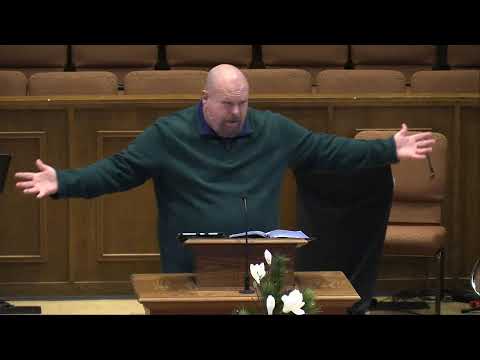
This guest blog post draws directly from First Baptist Church Union's sermon “Sunday Morning Worship” so you can keep engaging with the message all week. Read, reflect, and share it with your small group or friends.
Who Do You Say That I Am? The Christ Who Came for the Cross
This past Sunday, Pastor Mike led us through a powerful examination of Mark 8:27-33, where Jesus asks perhaps the most important question any of us will ever answer: "Who do you say that I am?" As our congregation gathered in the warmth of our church on a cold winter morning, we were challenged to consider not just whether we acknowledge Jesus existed, but whether we truly understand His mission.
The Questions That Define Us
Pastor Mike began by setting the context of this pivotal passage. Jesus and His disciples were traveling to the villages of Caesarea Philippi when He asked them two critical questions. The first was about public opinion: "Who do people say that I am?" The disciples responded with what they'd heard—some thought He was John the Baptist returned, others Elijah, and still others thought He must be one of the prophets.
What struck me was Pastor Mike's observation that all these answers had something in common—they all referred to people who were gone. The crowds recognized Jesus had power that must have come from heaven, but they couldn't quite place who He truly was.
Then came the more personal question that echoes through the centuries to each of us: "But who do you say that I am?" Peter's response was immediate and profound: "You are the Christ."
Understanding "The Christ"
Pastor Mike helpfully clarified three important aspects about Peter's confession:
First, "Christ" is not Jesus' last name but a title—the Greek equivalent of the Hebrew word "Messiah," meaning the promised one of God. The Old Testament provided numerous prophecies about the Christ: born in Bethlehem, sinless and blameless, a suffering servant, the perfect sacrifice, and the one through whom all nations would be blessed.
Second, this confession requires divine revelation. As Jesus explained in Matthew 16:17: "Blessed are you, Simon Bar-Jonah! For flesh and blood has not revealed this to you, but my Father who is in heaven." We don't arrive at this conclusion through superior intelligence or morality, but through God's gracious revelation.
Third, this confession demands human responsibility. While God must open our eyes, we must see and confess. As Romans 10:9 reminds us: "If you confess with your mouth that Jesus is Lord and believe in your heart that God raised him from the dead, you will be saved."
The Mission of the Messiah
After Peter's confession, Jesus began to teach them about His true mission. In Mark 8:31, we read: "And he began to teach them that the Son of Man must suffer many things and be rejected by the elders and the chief priests and the scribes and be killed, and after three days rise again."
Pastor Mike pointed out that Jesus outlined His mission in four parts:
- He must suffer many things
- He will be rejected by religious leaders
- He will be killed
- After three days, He will rise again
This wasn't a last-minute plan or a reaction to opposition. As Isaiah had prophesied 700 years earlier in Isaiah 53, the Messiah would be "pierced for our transgressions" and "crushed for our iniquities." The cross wasn't Plan B—it was God's divine purpose all along.
The Warning: Rebuking Christ
What happened next reveals how even those closest to Jesus could misunderstand His mission. Peter, who had just correctly identified Jesus as the Christ, took Him aside and began to rebuke Him! Peter had absorbed the cultural theology that the Messiah would be a conquering king, not a suffering servant.
Jesus' response was swift and severe: "Get behind me, Satan! For you are not setting your mind on the things of God, but on the things of man" (Mark 8:33).
Pastor Mike drew a powerful parallel to our own lives. How often do we rebuke Christ, not with our words but with our actions? God speaks plainly in His Word about love, sex, church membership, Scripture's authority, marriage, family, money, and countless other topics—yet we often set these truths aside when they don't align with our cultural preferences or personal desires.
The Call to Clear Vision
The sermon connected beautifully to last week's message about the blind man at Bethsaida who needed Jesus' touch twice before he could see clearly. Peter saw enough to recognize Jesus as the Christ, but his vision was too fuzzy to understand that the Messiah would have both a crown and a cross.
Pastor Mike closed with a powerful invitation: Christ is asking each of us the same question today—"Who do you say that I am?" We can say many right things about Jesus and still miss Him entirely. We can call Him teacher while rejecting His teaching, call Him Lord while following Him only when convenient, or say we believe the Bible while obeying only what agrees with our preferences.
The true Christ of Scripture came to save sinners—rebels, idolaters, hypocrites, the self-righteous, and the self-ruined. He suffered, was rejected, was killed, and rose again so that everyone who repents and believes in Him will be saved.
Our Response
As we left the service, many of us felt challenged to examine whether we follow the Jesus of Scripture or a Jesus of our own making. Do we set our minds on the things of God or the things of man? Are we willing to embrace both the crown and the cross of Christ?
If you missed Sunday's powerful message, I encourage you to watch it online. This teaching reminds us that correctly identifying Jesus as the Christ is only the beginning—we must also embrace His mission and follow Him on His terms, not ours.
"As the deer pants for flowing streams, so my soul longs for you, O God." - Psalm 42:1
#WhoIsJesus #TheChrist #MarkGospel #CrossAndCrown #BiblicalTeaching