
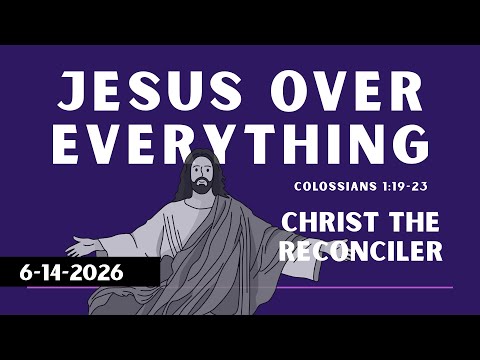
This small group discussion guide draws directly from Payton Horne's sermon “Crossroads Community Church of Stokesdale” so you can keep engaging with the message all week. Read, reflect, and share it with your small group or friends.
Small Group Discussion Guide
"The Depth of Our Alienation, The Glory of Our Salvation"
Based on Colossians 1:19-23 | Jesus Over Everything Series
A Note to Facilitators: This guide is designed to take 60–90 minutes. You don't need to cover every question — feel free to choose the ones that best fit your group. The goal isn't to get through all the material; it's to have one or two genuinely meaningful conversations. Trust the Holy Spirit to lead, and trust your group to go where they need to go.
OVERVIEW
In this sermon from the Jesus Over Everything series, the pastor draws from Colossians 1:19-23 to make a central claim: to truly appreciate the glory of our salvation, we must first understand the depth of our alienation from God. Using the harrowing story of the USS Indianapolis, he illustrates that the greater the peril, the greater the gratitude for rescue. Paul doesn't describe us as merely confused or misguided before Christ — he uses stark language: alienated, hostile in mind, doing evil deeds. But the breathtaking good news is that this same God, in whom all fullness dwells, reconciled his enemies to himself through the blood of the cross — making us holy, blameless, and above reproach.
SCRIPTURE READING (5 minutes)
Have someone in the group read the passage aloud. Encourage everyone to follow along and listen for a word or phrase that stands out to them.
Colossians 1:19-23 (ESV)
"For in him all the fullness of God was pleased to dwell, and through him to reconcile to himself all things, whether on earth or in heaven, making peace by the blood of his cross.
And you, who once were alienated and hostile in mind, doing evil deeds, he has now reconciled in his body of flesh by his death, in order to present you holy and blameless and above reproach before him, if indeed you continue in the faith, stable and steadfast, not shifting from the hope of the gospel that you heard, which has been proclaimed in all creation under heaven, and of which I, Paul, became a minister."
Brief Context for Facilitators: Paul is writing to the church in Colossae — a city that experienced frequent, devastating earthquakes. The buildings were not engineered to withstand them, so collapses were common. When Paul uses words like stable, steadfast, and not shifting, his readers would have felt the weight of those words immediately. He's essentially saying: when life shakes, be the kind of structure that doesn't fall.
ICEBREAKER (5–10 minutes)
Choose one of the following to open your time together:
Option A (lighter, fun): "Have you ever been rescued from something — big or small — and felt genuinely overwhelmed with gratitude? Maybe someone helped you change a tire, pulled you out of a tough situation, or stepped in at just the right moment. What happened, and how did it feel?"
Option B (slightly more reflective): "Think of a time when you didn't fully appreciate something until later — maybe a relationship, an opportunity, or even your health. What helped you eventually see it differently?"
[Leader Tip]: Don't overthink the icebreaker — its job is simply to get people talking and comfortable. Either option naturally sets up the sermon's central idea: that the depth of a rescue shapes the depth of our gratitude. You don't need to make that connection explicit yet; let it emerge naturally in the discussion.
DISCUSSION QUESTIONS (30–45 minutes)
Work through as many of these as time and conversation allow. They are organized from observational (easier) to applicational (deeper). You know your group — start where they are.
SECTION 1: The Rescue — Understanding Our Situation
Getting into the story and the sermon's central idea
1. What stood out to you most from Sunday's message — a story, a phrase, an image, or a scripture? Why did that particular thing grab your attention?
[Leader Tip]: This is a great opening question because there's no wrong answer. It also helps you quickly gauge what resonated with different people in your group, which can guide where you spend more time. Give everyone a chance to share briefly before moving on.
2. The pastor described the survivors of the USS Indianapolis and said: "No one who has been rescued from certain death responds with mild gratitude. The greater the peril, the greater the reaction in the appreciation for the rescue." How does that principle connect to how we think about our own salvation?
Follow-up if needed: Do you think most Christians — yourself included — tend to feel "mildly grateful" or "overwhelmingly grateful" for their salvation? What shapes that difference?
3. The pastor said: "If you think you were merely inconvenienced by sin, then Jesus becomes nothing more than a helpful guide. But if you understand that you were alienated from God... then Jesus becomes your rescuer." What's the difference between seeing Jesus as a "helpful guide" versus a "rescuer"? How does that difference show up in the way someone actually lives?
SECTION 2: The Alienation — Who We Were Before Christ
Sitting with the harder truths of this passage
4. Paul uses three specific phrases to describe our condition before Christ: alienated, hostile in mind, and doing evil deeds. Which of these three is hardest for you to personally identify with — and why do you think that is?
[Leader Tip]: This question might feel a little uncomfortable, and that's okay. Some people — especially those who grew up in church or came to faith young — may struggle to see themselves in this description. Gently affirm that Paul's language applies universally (the pastor made this point explicitly). If the group gets quiet, you might share your own honest reflection first to model vulnerability.
5. The pastor made this observation: "People don't naturally drift toward God, they drift away. The greatest miracle isn't that sinners are seeking God — the greatest miracle is that God is seeking sinners." How does this challenge the way our culture tends to think about spirituality and "finding God"?
Related Scripture to read aloud if helpful: Romans 3:10-11 — "None is righteous, no, not one; no one understands; no one seeks for God." Luke 15:4-6 — The parable of the lost sheep, where the shepherd leaves the ninety-nine to find the one.
SECTION 3: The Reconciliation — What Christ Has Done
The heart of the gospel in this passage
6. In verse 20, Paul says Christ made "peace by the blood of his cross." The pastor pointed out that peace always costs something — in war, peace treaties cost land, resources, and money. How does thinking about the cost of our peace with God change the way you relate to it?
7. Paul says that because of what Christ has done, we are now holy, blameless, and above reproach. The pastor described these as our identity — not something we earn, but something Christ gives us. Which of these three words is most meaningful to you personally right now, and why?
- Holy — set apart for God, chosen with purpose
- Blameless — without defect, without spot
- Above reproach — no accusation can stick against you
[Leader Tip]: This question often opens up rich, personal sharing. Some people carry deep shame from their past and have never truly received these words as their own. Others may intellectually agree but struggle to feel it. Both responses are valid and worth exploring. You might read Romans 8:1 and 8:33-34 alongside this if the group wants to go deeper.
Romans 8:1 — "There is therefore now no condemnation for those who are in Christ Jesus." Romans 8:33-34 — "Who shall bring any charge against God's elect? It is God who justifies. Who is to condemn? Christ Jesus is the one who died — more than that, who was raised — who is at the right hand of God, who indeed is interceding for us."
8. The pastor said: "A lot of us as believers like to sit in our past and in our shame." Why do you think it's so hard for Christians to actually receive the identity God has given them — holy, blameless, above reproach — even years after coming to faith?
Follow-up: What voices or experiences tend to make it hardest for you to believe what God says about you?
SECTION 4: The Perseverance — Continuing in the Faith
What it looks like to stay rooted
9. Paul closes this passage with a call to "continue in the faith, stable and steadfast, not shifting." The pastor connected this to the earthquake-prone city of Colossae, where buildings kept collapsing. What are the "earthquakes" — the things that shake people's faith — that you see most commonly today? What does it look like to remain stable and steadfast through them?
[Leader Tip]: This question can open up honest conversation about doubt, suffering, unanswered prayer, and the struggles of the Christian life. Welcome that honesty. The goal isn't to give pat answers but to acknowledge real struggles while pointing to the unshifting hope of the gospel.
10. The pastor asked: "Will you still trust Christ when your prayers seem unanswered? When suffering comes? When following is harder than you'd like?" When has continuing in faith been most difficult for you — and what helped you keep going?
PERSONAL APPLICATION (10–15 minutes)
Invite the group to take a few minutes of quiet reflection before sharing, or let people respond directly. These questions are more personal — create a safe, grace-filled space.
1. On a scale of "mildly grateful" to "overwhelmingly grateful," where would you honestly say you are right now in your appreciation for your salvation? What do you think is shaping that?
2. Is there an area of your life where you're still living out of shame or your old identity rather than the identity Christ has given you — holy, blameless, above reproach? What would it look like to start believing that truth this week?
3. The pastor said Paul is asking, "Where else are you going to go but to Christ?" Are there places in your life right now where you're looking for satisfaction, fulfillment, or rescue somewhere other than Jesus? What would it look like to turn back to him in that area?
THIS WEEK'S CHALLENGE
Choose one (or more) of the following to carry with you into the week ahead:
📖 Reflect: Take 10 minutes this week to sit quietly with Colossians 1:21-22. Read it slowly, inserting your own name: "And [your name], who once was alienated and hostile in mind... he has now reconciled... in order to present [your name] holy and blameless and above reproach." Let it sink in. Journal anything that comes up.
💬 Share: Tell someone — a friend, a family member, or someone in your group — the specific thing Christ rescued you from. Practice putting language to the depth of your alienation so you can better articulate the glory of your salvation.
🙏 Pray: Spend time this week thanking God not just for what he gave you (forgiveness, peace, eternal life), but for what he rescued you from. Let the gratitude go deeper than usual.
🤝 Serve: Is there someone in your life who is still "adrift" — alienated from God? Pray for them by name this week, and ask God to show you one concrete way to point them toward Christ.
PRAYER FOCUS (5–10 minutes)
Close your time together in prayer. Here are suggested prayer themes — feel free to use them as a guide or invite the group to pray freely:
Gratitude — Thank God for the specific reality of your reconciliation. Encourage the group to pray with the language of the passage: "Thank you that I am holy, blameless, and above reproach because of Jesus."
Deeper appreciation — Ask God to give your group a clearer picture of the depth of your alienation, so that your gratitude for salvation grows.
Stability — Pray for those in the group facing "earthquakes" right now — situations that are shaking their faith, their family, their health, or their hope. Ask God to make them stable, steadfast, and unshifting.
Those who are still adrift — Pray for specific people in your lives who don't yet know Christ. Ask God to pursue them the way he pursued you.
[Leader Tip]: If your group isn't comfortable praying aloud, you can close in prayer yourself, incorporating the themes above. Or you can invite people to share one prayer request and then pray over them together. Even a brief, genuine closing prayer is more valuable than a long one that feels forced.
OPTIONAL DEEP DIVE
For groups with extra time or those wanting to go further
1. The pastor introduced the concept of the "hypostatic union" — the theological truth that Jesus is both fully God and fully human. He explained why both matter: if Jesus were only human, he'd be sinful and couldn't save us; if he were only God, he couldn't shed blood for us. How does understanding who Jesus is shape how you understand what Jesus did? Why does it matter that the one who reconciled us was both God and man?
Related passages: John 1:1, 14; Hebrews 2:14-17; Philippians 2:6-8
2. In verse 20, Paul says Christ reconciled "all things, whether on earth or in heaven." The scope here is cosmic — not just individual souls, but all of creation. How does the idea that Christ's reconciliation extends to all things expand your understanding of the gospel beyond personal salvation? What does that mean for how we engage with the world around us?
Related passages: Romans 8:19-22; Revelation 21:1-5; Isaiah 65:17
3. The pastor mentioned that throughout the New Testament, perseverance is a sign of salvation — not what earns it, but what evidences it. How do you hold that truth in tension with the assurance that salvation is by grace through faith alone? What does healthy perseverance look like, and how is it different from anxious striving to "stay saved"?
Related passages: Hebrews 12:1-3; Philippians 1:6; John 10:27-29; 1 John 5:13
ADDITIONAL SCRIPTURE FOR FURTHER STUDY
For those who want to continue exploring this week's themes on their own:
| Theme | Passage |
|---|---|
| Our condition before Christ | Ephesians 2:1-5 |
| The fullness of Christ | Colossians 2:9-10 |
| No condemnation in Christ | Romans 8:1, 31-39 |
| Peace through the cross | Romans 5:1-11 |
| Our new identity in Christ | 2 Corinthians 5:17-21 |
| Perseverance in faith | Hebrews 12:1-3 |
| God seeking the lost | Luke 15:1-7 |
QUICK-REFERENCE GUIDE FOR FACILITATORS
| Section | Suggested Time |
|---|---|
| Welcome & Icebreaker | 5–10 min |
| Scripture Reading | 5 min |
| Discussion Questions | 30–45 min |
| Personal Application | 10–15 min |
| This Week's Challenge | 3–5 min |
| Prayer | 5–10 min |
| Total | 60–90 min |
If you only have time for 3 questions, choose:
- Question 2 (the rescue illustration)
- Question 7 (holy, blameless, above reproach)
- Question 10 (continuing in faith through difficulty)
If your group is mostly new believers, spend more time on:
- Questions 3, 6, and 7
If your group is mostly mature believers, spend more time on:
- Questions 5, 8, and the Optional Deep Dive questions
"To better appreciate the glory of your salvation, you need to understand the depth of your alienation." — Sermon, Colossians 1:19-23
This guide was prepared for small group use in connection with the Sunday sermon. Please feel free to adapt questions, skip sections, or linger longer where the Spirit leads. The goal is genuine conversation and real transformation — not completing a worksheet.