
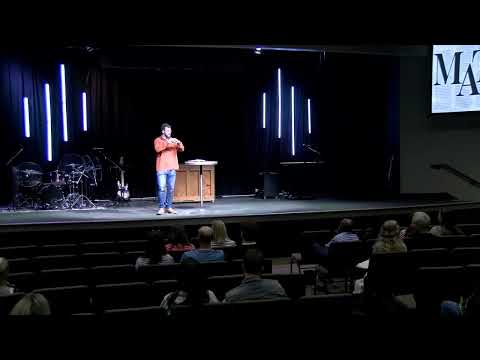
This small group discussion guide draws directly from Tanner Dalton's sermon “4/19/26 | Matthew 1:18–25” so you can keep engaging with the message all week. Read, reflect, and share it with your small group or friends.
Small Group Discussion Guide
The Origin of Jesus | Matthew 1:18–25
A Note to Facilitators Welcome, and thank you for leading your group this week! This guide is designed to help your group engage meaningfully with Sunday's sermon on the origin of Jesus. You don't need to be a theological expert — your role is simply to create space for honest conversation and guide people toward the scriptures. Feel free to adapt questions to fit your group's needs, skip questions if time is short, and follow the Spirit's leading. Estimated times are suggestions, not rules. You've got this!
OVERVIEW
In Matthew 1:18–25, Matthew gives us more than a birth announcement — he gives us the origin story of the King of kings. Through the unexpected circumstances surrounding Jesus's birth, we discover two profound truths: Jesus is Savior, the one who rescues his people from sin, and Emmanuel, God himself dwelling among us. Joseph's quiet, courageous obedience in the face of confusion and fear becomes a model for how we're called to respond when God interrupts our plans with something we don't yet fully understand.
Big Idea: In the birth of Jesus, God reveals him as both Savior and Emmanuel, calling his people to respond in trusting obedience.
BEFORE YOU BEGIN
A Quick Glance at the Flow:
| Section | Estimated Time |
|---|---|
| Icebreaker | 5–10 minutes |
| Scripture Reading | 5 minutes |
| Discussion Questions | 30–45 minutes |
| Personal Application | 10–15 minutes |
| Prayer Focus | 5–10 minutes |
| Total | 55–85 minutes |
Optional Deep Dive questions are available at the end for groups with extra time or a desire to go further.
SECTION 1 — ICEBREAKER
(5–10 minutes)
Everyone loves a good origin story — whether it's a superhero's backstory, a family legend, or the story of how a friendship began.
Opening Question:
"What's one detail from your own background — a place, a person, a family tradition, or a formative experience — that helped shape who you are today? Share a brief slice of your origin story."
[Leader Tip] This question is intentionally light and personal to help people warm up and feel seen before diving into scripture. Share your own answer first to model vulnerability and set the tone. Keep this section moving — aim for 1–2 minutes per person.
SECTION 2 — SCRIPTURE READING
(5 minutes)
Have someone read the passage aloud. Encourage the group to listen as if hearing it for the first time.
Matthew 1:18–25 (NIV)
"This is how the birth of Jesus the Messiah came about: His mother Mary was pledged to be married to Joseph, but before they came together, she was found to be pregnant through the Holy Spirit. Because Joseph her husband was faithful to the law, and yet did not want to expose her to public disgrace, he had in mind to divorce her quietly.
But after he had considered this, an angel of the Lord appeared to him in a dream and said, 'Joseph son of David, do not be afraid to take Mary home as your wife, because what is conceived in her is from the Holy Spirit. She will give birth to a son, and you are to give him the name Jesus, because he will save his people from their sins.'
All this took place to fulfill what the Lord had said through the prophet: 'The virgin will conceive and give birth to a son, and they will call him Immanuel' (which means 'God with us').
When Joseph woke up, he did what the angel of the Lord had commanded him and took Mary home as his wife. But he did not consummate their marriage until she gave birth to a son. And he gave him the name Jesus."
Isaiah 7:14 (NIV)
(The Old Testament prophecy Matthew quotes)
"Therefore the Lord himself will give you a sign: The virgin will conceive and give birth to a son, and will call him Immanuel."
John 1:1, 14 (NIV)
(Referenced in the sermon for context on Jesus's eternal nature)
"In the beginning was the Word, and the Word was with God, and the Word was God... The Word became flesh and made his dwelling among us. We have seen his glory, the glory of the one and only Son, who came from the Father, full of grace and truth."
SECTION 3 — DISCUSSION QUESTIONS
(30–45 minutes)
Work through as many questions as your group has time for. Questions are organized from lighter and observational to deeper and more personal. You don't need to cover every question — choose the ones that fit your group best.
PART A: WHAT WE SEE IN THE TEXT
Getting into the story together
1. What stood out to you most from Sunday's message or from reading this passage just now? Was there anything that surprised you, confused you, or hit differently than you expected?
[Leader Tip] This is your "landing pad" question — it invites everyone in without pressure and surfaces the themes your group is most drawn to. There's no wrong answer. If the group is quiet, share what stood out to you first, then invite others.
2. The sermon described Joseph's situation as "messy" — Mary shows up four months pregnant, and Joseph doesn't yet know what we know as readers. Put yourself in Joseph's shoes for a moment. What do you imagine he was feeling in that moment? What would have been going through your mind?
3. Verse 19 describes Joseph as "faithful to the law" (or "righteous") and yet someone who chose not to expose Mary to public disgrace. The sermon pointed out that he held both righteousness and mercy at the same time.
- Why do you think it's so hard for us as humans to hold both of those things together?
- When someone wrongs us, what do we tend to reach for first — justice or mercy? Why do you think that is?
[Leader Tip] This question often generates honest and sometimes convicting conversation. Normalize the tension — the point isn't to shame anyone for wanting justice, but to notice the pattern and let Joseph's example (and ultimately God's example) challenge us. If the group gets stuck, ask: "Can you think of a time when someone extended mercy to you when you deserved consequences? What did that feel like?"
PART B: WHAT THE NAMES REVEAL
Unpacking the identity of Jesus
4. Jesus is given two names in this passage — Jesus (meaning "the Lord saves") and Emmanuel (meaning "God with us"). The sermon said these two names together reveal who Jesus truly is.
- What's the difference between someone who is sent by God and someone who is God with us? Why does that distinction matter?
- What changes about how you relate to Jesus if he is not just a representative of God, but God himself present with you?
5. Matthew quotes Isaiah 7:14 — a prophecy written roughly 700 years before Jesus was born — and says it was fulfilled in the virgin birth. The sermon mentioned that Matthew uses a "fulfillment formula" throughout his gospel, connecting the story of Jesus to the long story of God's promises.
- What does it mean to you that God was working out this plan for hundreds of years before it happened?
- How does knowing that God fulfills his promises in his own time and way affect how you trust him with things in your own life that feel unresolved?
[Leader Tip] This question bridges the historical/theological and the personal. Some in your group may be wrestling with unanswered prayers or long-delayed hopes. Invite people to be honest without pushing anyone to share more than they're comfortable with.
6. The sermon closed with the bookends of Matthew's gospel — Jesus is called "Emmanuel, God with us" at the beginning (Matthew 1), and at the end (Matthew 28:20) Jesus says, "I am with you always, to the very end of the age."
- What does it mean practically — not just theologically — that Jesus is with you right now, in your actual life this week?
- Is that truth easy or hard to feel? What makes it feel real, and what makes it feel distant?
PART C: JOSEPH'S RESPONSE — AND OURS
Moving from observation to action
7. When Joseph woke up from the dream, the text says he immediately did what the angel commanded. The sermon broke down his response into three parts: he obeyed immediately, he obeyed completely, and he obeyed without full understanding.
- Which of those three is hardest for you personally? Why?
- What does it look like in everyday life to obey God before you have all the answers?
8. The angel's first words to Joseph were: "Do not be afraid." The sermon pointed out that Joseph's obedience would likely cost him social standing and reputation — he was choosing a path that would invite judgment from others.
- What fears most often keep you from doing what you sense God is calling you to do?
- How do you personally push through fear when it comes to following God?
[Leader Tip] This is one of the most personally vulnerable questions in the guide. Give people permission to be honest — fear is universal and nothing to be ashamed of. If the group is hesitant, you might offer a personal example of a time fear held you back, or a time you stepped through it.
9. The sermon referenced the story of Jean Valjean from Les Misérables — a man whose life was transformed by an act of unexpected, extravagant mercy. The bishop's mercy didn't just let Valjean off the hook; it changed him.
- Has someone ever shown you mercy when you deserved something else? How did it affect you?
- Is there someone in your life right now — someone easy to love or hard to love — who might need you to extend that kind of mercy? What's standing in the way?
SECTION 4 — PERSONAL APPLICATION
(10–15 minutes)
These questions are designed for quieter, more personal reflection. You may want to give people 2–3 minutes of quiet to think before inviting sharing. Not everyone needs to answer aloud — encourage honesty over performance.
Reflection Questions:
The sermon said, "The origin story of Jesus is messy — and that's exactly how God intended it." Is there something in your own life right now that feels messy, confusing, or out of your control? How might this passage speak into that situation?
Joseph obeyed without full understanding. What is one area of your life where God might be asking you to take a step of obedience even though you don't have all the answers yet?
Christianity, the sermon reminded us, is not about us reaching up to God — it's about God coming down to us. How does the truth that Jesus is Emmanuel — God with you — change how you approach your ordinary week?
🗓 THIS WEEK'S CHALLENGE
Choose one (or more) that fits where you are:
Reflect: Spend 10 minutes this week sitting quietly with the phrase "God is with me" — in your car, on a walk, or before bed. Let it move from information to something you actually feel and believe.
Act: Think of one person in your life who needs mercy extended to them — someone who has hurt you, disappointed you, or made things complicated. Take one small step toward mercy this week: a text, a conversation, a decision to let something go.
Share: Tell someone — a friend, a family member, a coworker — something about what it means that Jesus is Emmanuel, God with us. It doesn't have to be a formal gospel presentation. Just share what this truth means to you personally.
Explore: Read through Matthew 28:16–20 (the Great Commission) and notice how Jesus closes with the same promise — "I am with you always." Sit with the connection between the beginning and the end of Matthew's gospel.
SECTION 5 — PRAYER FOCUS
(5–10 minutes)
Close your time together in prayer. You might pray as a group, invite one person to lead, or use the prompts below to guide a time of open prayer.
Suggested Prayer Themes:
Gratitude — Thank God for sending Jesus not just to us but as one of us. Thank him that Emmanuel means he is truly, literally with us.
Honesty — Bring before God the areas of life that feel messy or confusing right now. Acknowledge where fear has held you back from obedience.
Mercy — Ask God to give you the grace to hold righteousness and mercy together — to be people who extend to others what God has extended to us.
Courage — Pray specifically for anyone in the group who is facing a step of obedience they've been hesitant to take. Ask God to replace fear with trust.
Presence — Close by simply acknowledging together that Jesus is Emmanuel — God with us — in this room, in this group, and in each person's life this week.
[Leader Tip] If your group is comfortable with it, invite people to pray briefly for the person to their right, or invite open prayer around the themes above. If your group is newer or quieter, simply close with a prayer yourself using these themes. Either way, end with confidence and warmth — God is with you all.
OPTIONAL DEEP DIVE
For groups with extra time or a hunger to go further
Bonus Question 1 — The Trinity in the Birth Narrative
The sermon pointed out that all three persons of the Trinity are present in this passage: God the Father is orchestrating the plan, the Holy Spirit conceives Jesus in Mary's womb, and the Son takes on flesh. Read Matthew 1:18–21 alongside John 1:1–14.
- What does the active involvement of the Holy Spirit in the conception of Jesus tell us about the Spirit's role — not just in the birth of Jesus, but in new birth and transformation in our own lives?
- How does the Trinity working together in this moment shape your understanding of who God is?
Bonus Question 2 — The Fulfillment Formula
Matthew quotes Isaiah 7:14 and says Jesus "fulfilled" this prophecy. The original context of Isaiah 7 was a message to King Ahaz during a political crisis — the promise of a sign that God was still present with his people.
- What does it mean that God's promises often have layers — a near fulfillment and a deeper, ultimate fulfillment centuries later?
- How does this pattern of fulfillment in scripture give you confidence that God's promises to you personally will also be fulfilled — even if the timing and shape look different than you expect?
Bonus Question 3 — Righteousness and Mercy
The sermon highlighted that Joseph held both righteousness and mercy at the same time — a rare and beautiful combination. Read Micah 6:8 and Romans 3:21–26.
- How does the cross of Jesus become the ultimate place where God's righteousness and his mercy meet?
- What does it look like for a community — not just individuals — to be known for holding both justice and compassion together?
ADDITIONAL SCRIPTURE FOR FURTHER STUDY
| Passage | Theme |
|---|---|
| Isaiah 7:10–14 | The original Immanuel prophecy in context |
| John 1:1–18 | The eternal Word becoming flesh |
| Micah 5:2–5 | The Messiah's origin prophesied |
| Romans 3:21–26 | God's righteousness and mercy meeting at the cross |
| Matthew 28:16–20 | The Great Commission — "I am with you always" |
| Philippians 2:5–11 | The humility of the incarnation |
QUICK REFERENCE FOR FACILITATORS
If discussion stalls: Return to the text. Ask, "What does this verse actually say? What do you notice?" Observation questions always restart conversation.
If one person dominates: Warmly redirect with, "That's really helpful — I'd love to hear from someone who hasn't shared yet. What's your take?"
If someone shares something painful: Don't rush to fix it. Acknowledge it: "Thank you for sharing that. That sounds really hard." Then invite the group to pray for them at the end.
If theological questions arise you can't answer: It's okay to say, "That's a great question — I'm not sure I know the full answer. Let's look it up this week and come back to it." Honesty builds trust.
If you're short on time: Prioritize Questions 3, 7, and 8 from the discussion section, and always leave time for prayer.
This guide was created for small group use in connection with the sermon series in the Gospel of Matthew. Feel free to reproduce and distribute freely within your church community.