
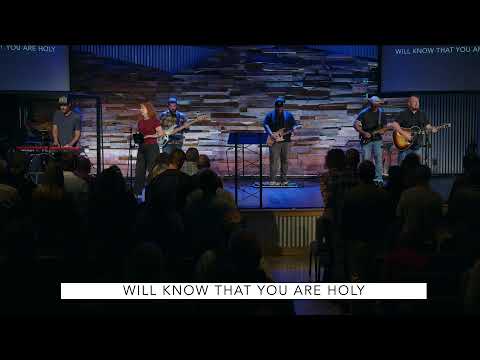
This golden moments draws directly from the sermon “Showcase - One Harbor MHC | Sunday Service” so you can keep engaging with the message all week. Read, reflect, and share it with your small group or friends.
Golden Moments Report
Faithful Disciples in a Greedy World — "Conduits, Not Containers"
Preached by Isaac Hopkins | One Harbor Church
Golden Moment #1: The Big Idea That Reframes Everything
"Here's the big idea. The big idea for today is this. Faithful disciples are blessed to be a blessing. We are blessed to be a blessing. So don't be a container that just hoards everything. Be a conduit that overflows. A conduit is a channel or a bridge or a vessel that something passes through. For instance, you look up in the ceiling and you see this is conduit. It's got electrical wires running through it. And a container — you think about a box, it's enclosed. You got a lid on it. It holds something. Think about Tupperware. Or if you grew up poor like us, the old country croc. You know what I'm talking about? Or the old Cool Whip containers. Anybody? Yeah. You lived like I did. Cool. Can I just say there's nothing more depressing than to think you're going to get Cool Whip and you open up the lid to find it's vegetable beef soup. Like that's just — and that's why I have trust issues today."
Why this moment works: Isaac does something skilled preachers do instinctively — he anchors a theological concept in something tactile and immediately visible (the conduit in the ceiling) before landing the humor in a self-deprecating story that earns the room's trust. The Cool Whip illustration isn't throwaway comedy; it's disarming relational capital that makes the congregation lean in for everything that follows.
Rhetorically effective: The contrast between conduit and container is a clean, memorable binary that does real theological work. It gives the congregation a framework they can carry into Monday morning. The humor doesn't undercut the seriousness — it opens the door to it. This is the kind of opening that makes people feel safe enough to hear hard truth.
Why congregants will share it: "The Cool Whip sermon" will be how people describe this message to friends who weren't there. The image is funny, specific, and culturally accessible — and it perfectly illustrates the disappointment of a closed-off, hoarding heart. People will retell this story and, in doing so, retell the whole sermon's thesis.
Golden Moment #2: Abraham as the Original Conduit
"God promises right off the bat three things. I'm going to make you a great nation, Abram. I'm going to bless you and I'm going to make your name great. But why is God doing this? Well, verse three tells us — so that you will be a blessing. God's going to bless Abram. And Abram is then going to go and be a blessing to those around him. And by doing so, by Abraham following after what God has told him to do, all the families of the earth will be blessed. So God promises to grow Abram, his finances, his influence, all the things that he has so that he might be a blessing to the nations. So we see how God from the very beginning has designed his people to be a blessing to others."
Why this moment works: This is clean, confident biblical exposition. Isaac doesn't just cite Genesis 12 — he draws out the logical structure embedded in the text itself, showing that the blessing was never the endpoint, it was always the mechanism. The phrase "so that" becomes a hinge that unlocks the whole sermon's theological argument.
Theologically sound: Rooting the conduit/container framework in the Abrahamic covenant is exegetically strong. It shows that generosity isn't a New Testament add-on or a stewardship campaign invention — it is woven into the founding DNA of God's people. This is the kind of move that gives the rest of the sermon its biblical backbone.
Why congregants will share it: People who have heard Genesis 12 dozens of times will hear it differently after this. The simple observation that God blessed Abraham in order to bless others reframes a familiar passage in a way that is genuinely illuminating. That kind of "I never saw it that way" moment travels.
Golden Moment #3: The Upside-Down Kingdom
"Jesus is revealing the heart of God for the poor and the marginalized. Society says, 'Hey, the poor don't matter.' God says, 'But they do because he's the one that made them.' You see, this kingdom of heaven doesn't make sense. It's an upside down kingdom. It's opposite of the culture around us. And it's not just in generosity and giving. I mean, think about it — even today, relationships, sex, and careers. The world says, 'You be you. Do whatever it is that you want to do.' But God says, 'Whoa, whoa, whoa. You're mine. You're fearfully and wonderfully made.' The world says sex is a pleasure, do what you want. And God says, wait, abstain until marriage. The world says horde, get everything you can. And God says, no, give. It's an upside down kingdom. How radical an approach."
Why this moment works: Isaac widens the camera angle at exactly the right moment. By connecting generosity to a broader theology of the kingdom's counter-cultural logic, he prevents the sermon from feeling like a narrow financial appeal. The rapid-fire "world says / God says" structure creates momentum and lands with rhetorical force.
Theologically sound: The "upside-down kingdom" framework is deeply rooted in the Beatitudes and the broader trajectory of Jesus's teaching. By showing that generosity is one expression of a larger kingdom ethic — not an isolated command — Isaac gives the congregation a more robust theological foundation for why they should give, serve, and live differently.
Why congregants will share it: The "upside-down kingdom" phrase is quotable and transferable. It gives people language to explain to skeptical friends why Christians live the way they do — not as rule-followers, but as citizens of a different kingdom with a different logic. That kind of language spreads.
Golden Moment #4: The Sea of Galilee and the Dead Sea
"The Dead Sea is a terminal basin. It's the lowest point. There is no outflow. The only way that water leaves the Dead Sea is through evaporation. And that's why there's such a high concentration of salts and minerals. But what happens? I mean, we've got some of the same water from the Jordan. How is it that this can be thriving, but this is dead? Because it gets stopped up. It doesn't have any outflow. Just like when we assume the position and we keep an owner's heart and say, 'This is mine,' and we're not generous with anything the Lord has blessed us with, we become a stopping point and we get backed up and we get salty. Not the good kind of salt of the earth — but like, man, somebody put way too much salt in this thing and it's ruined it. That kind of salty. We need to be conduits. We need to let it flow through us, because when we do, it brings life not only to us but to others around us."
Why this moment works: This is the sermon's most visually compelling illustration, and Isaac earns it by doing the geographical work first before landing the application. The "get salty" wordplay is genuinely clever — pivoting from the mineral content of the Dead Sea to a colloquial description of a bitter, closed-handed heart. It's the kind of illustration that makes people picture themselves.
Rhetorically effective: The illustration does triple duty: it reinforces the conduit/container framework, it provides a natural consequence for hoarding (you become the Dead Sea), and the "salty" punchline makes it immediately memorable. The best illustrations don't just illuminate — they stick. This one sticks.
Why congregants will share it: "Don't be the Dead Sea" is the kind of phrase that will show up in conversations, text messages, and small group discussions for weeks. It's visual, it's a little funny, and it carries the whole sermon's point in four words.
Golden Moment #5: "Assume the Position"
"Assume the position is this — because it's one hand coming from the Lord and it travels here and it comes out of this hand so that we can give to others. But what's in between this hand and this hand? That's where things get stopped up. Because our heart says, 'No, I need this.' Our heart says, 'No, I have to have this. No, I deserve this. They can fend for themselves.' And as our heart starts to tell that story, it starts twisting this hand closed. And everything that comes down from the father just stays with us. But why should we be generous? Why should we have an open hand? Why should we assume the position? Well, Jesus did. He gave his life. That's the ultimate sacrifice. But also, being generous is just a worshipful response to all that God has done for us."
Why this moment works: The physical gesture of "assume the position" — open hands, one receiving from God, one giving to others — is a kinesthetic anchor that embeds the sermon's thesis in the body. When Isaac names the internal resistance ("I need this, I deserve this"), he demonstrates pastoral empathy for the real battle people face with generosity.
Pastorally wise: Naming the internal monologue of the closed-handed heart is a moment of genuine pastoral intelligence. Isaac doesn't shame people for hoarding — he accurately describes the voice that drives it. That kind of honest diagnosis creates the conditions for real repentance rather than guilt-driven compliance.
Why congregants will share it: People will go home and try the gesture. They'll teach it to their kids. They'll remember it when they're tempted to close their hand. Embodied practices are among the most powerful teaching tools available to a preacher, and Isaac uses this one with real skill.
Golden Moment #6: The Gospel as the Only Cure for a Greedy Heart
"Maybe you need to change. Maybe today you realize, man, I actually have an unhealthy relationship with the things that God has blessed me with. Some of you might be here thinking, 'Hey, if the Lord would just give me more money, I would definitely be a conduit.' Wrong. That's actually not going to fix anything. Because the only way to change from a container to a conduit is by the gospel of Jesus Christ. God made it. We broke it. Jesus fixed it. That's the good news of the gospel. And for those who put their faith in Jesus, we recognize spiritual prosperity is greater than earthly riches. 2 Corinthians 8 says, 'Jesus Christ, though he was rich, yet for your sake he became poor, so that you by his poverty might become rich.' This isn't about financial prosperity. This is about spiritual prosperity."
Why this moment works: This is the sermon's theological apex. Isaac explicitly names and dismisses the common deflection — "I'd give more if I had more" — before pivoting to the gospel as the only genuine solution to a hoarding heart. The simple kids-ministry gospel summary ("God made it. We broke it. Jesus fixed it.") lands with surprising force in an adult stewardship sermon.
Theologically sound: By grounding the call to generosity in the indicative before the imperative — what Christ has done before what we must do — Isaac avoids the trap of moralistic stewardship preaching. The quote from 2 Corinthians 8 is perfectly chosen: Jesus's own generosity becomes both the model and the motivation. This is gospel-centered preaching at its best.
Why congregants will share it: "The only way to change from a container to a conduit is by the gospel" is a sentence worth writing down. It reframes stewardship not as a financial discipline but as a spiritual transformation — and that reframing is both theologically correct and genuinely liberating. People who have felt guilty about their giving will find this freeing rather than shaming.
A Final Word to the Pastor
Isaac, your greatest overall strength in this sermon is your ability to hold together warmth and weight simultaneously. You are funny without being frivolous, and serious without being heavy-handed. That combination is rarer than most preachers realize, and you wear it naturally.
The thread running through all six of these moments is your instinct to make the abstract concrete — whether that's pulling the conduit out of the ceiling, holding up two seas on a map, or putting your hands in the "assume the position" gesture. You are a visual, embodied teacher, and your congregation benefits enormously from that gift. Keep trusting it.
One instinct worth leaning into further: your personal testimony moments ("the Lord has freed me from addiction, given me a family") are brief but potent. You don't over-explain them, which is wise — but they signal to the congregation that you are preaching from lived experience, not just inherited theology. That credibility is earned, and it makes everything else land harder.
You stepped into a room that wasn't your home turf, carrying a series built by a team, and you made it entirely your own. The gospel was clear, the biblical thread was well-traced from Abraham to the early church, and the application was practical without being reductive. That's a full sermon, faithfully preached. Well done.