
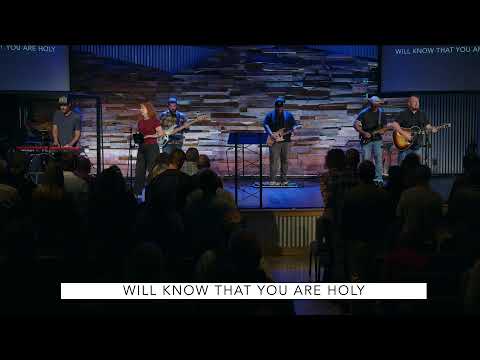
This guest blog post draws directly from the sermon “Showcase - One Harbor MHC | Sunday Service” so you can keep engaging with the message all week. Read, reflect, and share it with your small group or friends.
Conduits, Not Containers: Are You Holding On or Flowing Through?
Meta Description: What does it mean to be "blessed to be a blessing"? Pastor [Name] traced this thread through Scripture and challenged us to examine our hearts.
URL Slug: conduits-not-containers-blessed-to-be-a-blessing
Featured Image: A split image of the Sea of Galilee (vibrant, full of life) alongside the Dead Sea (barren, still) — or a simple overhead shot of open hands receiving and releasing water.
What would happen if a river suddenly had no outlet? It wouldn't stay a river for long.
That image — a body of water with nowhere to flow — sat at the heart of a powerful message this Sunday as Pastor [Name] walked us through one of the most consistent threads woven throughout all of Scripture: God blesses his people so that they can be a blessing to others. The question he left us wrestling with is a personal one: Are you a conduit, or a container?
The Big Idea: Blessed to Be a Blessing
Pastor [Name] opened with a simple but convicting distinction. A conduit is a channel — something a resource passes through. A container holds things in, lid on tight. And from the very first pages of the Bible, God's design for his people has always been the former, never the latter.
He took us to Genesis 12, where God calls Abram and makes a remarkable promise:
"I will make of you a great nation, and I will bless you and make your name great, so that you will be a blessing... and in you all the families of the earth shall be blessed." — Genesis 12:2-3
The blessing wasn't the destination. It was the fuel. God promised to grow Abram's influence, his finances, his legacy — not so he could hoard it, but so it could overflow to the nations around him. As Pastor [Name] pointed out, this pattern doesn't stop with Abraham. Jacob's presence brought blessing to his uncle Laban's household. Joseph's God-given wisdom fed an entire region through famine. Even in exile, God's people were instructed in Jeremiah 29 to "seek the welfare of the city where I have sent you... for in its welfare you will find your welfare."
From the very beginning, God's people have been called to be channels for the flourishing of others.
When Conduits Embrace Limits
One of the most striking sections of the message came as Pastor [Name] walked through the Law God gave Moses — and showed us that many of those laws weren't restrictions for their own sake. They were protections for the vulnerable.
He pointed to Exodus 22, where God instructed his people not to charge interest on loans to the poor, and even to return a neighbor's cloak used as collateral before sundown — because it might be the only thing keeping them warm at night. He walked us through Leviticus 19, where farmers were commanded not to harvest their fields to the very edge, leaving the margins for widows, orphans, and those passing through. He even described the Year of Jubilee, where every fifty years debts were cancelled, slaves were freed, and land was returned to families who had sold it under financial hardship.
These weren't arbitrary rules. They were God saying to his people: Don't let your prosperity come at the expense of someone else's dignity.
Jesus and the Upside-Down Kingdom
When Jesus arrives on the scene, he enters a world of extreme economic inequality — where roughly 2% of the Roman Empire's population controlled two-thirds of its wealth. And rather than validate the cultural assumption that poverty meant divine disfavor, Jesus flipped the script entirely.
"Blessed are you who are poor, for yours is the kingdom of God. Blessed are you who are hungry now, for you shall be satisfied." — Luke 6:20-21
Pastor [Name] reminded us that Jesus described this as a kingdom that simply doesn't operate like the world around it. And he went further — pointing to Matthew 25, where Jesus makes a stunning claim about what genuine faith actually looks like in practice:
"Truly, I say to you, as you did it to one of the least of these my brothers, you did it to me." — Matthew 25:40
Generosity, Pastor [Name] emphasized, is not optional for a follower of Christ. And it's broader than finances. Jesus' list in Matthew 25 — food, water, clothing, welcome, presence with the sick and imprisoned — is a reminder that generosity is about what you have, not a minimum dollar amount.
The Early Church Got It Right
The sermon came alive as Pastor [Name] described the radical generosity of the early church. In Acts 2, believers were "selling their possessions and belongings and distributing the proceeds to all as any had need" (Acts 2:45). In Acts 4, the result was striking: "There was not a needy person among them" (Acts 4:34).
This wasn't compelled by church leadership. It was voluntary — people who had seen the generosity of Christ responding in kind. Paul captured the spirit of it in 2 Corinthians 8, describing the Macedonian church: "They gave according to their means, as I can testify, and beyond their means of their own accord."
They gave regularly (1 Corinthians 16:2), cheerfully (2 Corinthians 9:7), and sacrificially. They were, as Pastor [Name] described them, conduits with open hands.
The Sea of Galilee and the Dead Sea
Perhaps the most memorable illustration of the morning was a simple map. The Jordan River flows into the Sea of Galilee — and also out of it, continuing south. The Sea of Galilee teems with life. The Jordan River then flows into the Dead Sea, which has no outlet. The water sits. It evaporates. The salt concentration climbs above 30%. Nothing lives there.
Same source. Completely different result — because one flows and one doesn't.
Pastor [Name] invited us to ask honestly: Which one are we more like?
He laid out four stages of a generosity journey — from the self-contained bucket (what's mine is mine) to the reluctant drip (I give when pressured) to the intentional steward (I give with purpose and planning) to the overflowing conduit (everything I have belongs to God, and I hold it loosely). None of us are the source. But we all get to choose whether we let it flow.
The Gospel Is the Starting Point
What made this message land with such weight was how Pastor [Name] grounded it all in the gospel. Changing from a container to a conduit isn't a willpower project — it's the work of Jesus in us.
As 2 Corinthians 8:9 says: "Though he was rich, yet for your sake he became poor, so that you by his poverty might become rich."
Jesus modeled the ultimate open-handed generosity. He gave everything. And when we remember that, truly remember it, it becomes the fuel for how we hold everything else.
If this message challenged you the way it challenged us, we'd love for you to watch the full sermon and share it with someone who needs the reminder this week. And if you're ready to take a next step — whether that's exploring generosity in community, taking a fresh look at how you steward what God has given you, or simply coming back next Sunday — we'd love to have you with us.
Social Media Excerpt (Facebook/Instagram): What's the difference between the Sea of Galilee and the Dead Sea? One flows. One doesn't. This Sunday, Pastor [Name] challenged us to ask a hard question: Are we conduits of God's blessing, or containers holding it all in? The answer might change everything. 🌊 Link to full blog post in bio.
Hashtags: #BlessedToBeABlessing #FaithfulDiscipleship #BiblicalGenerosity #OneHarborChurch #ConduitNotContainer